Enterprise semantic search and retrieval grounded in the organisation's own taxonomies, entities, and access policies - replacing keyword search across knowledge bases, contracts, policies, claims files, research libraries, and case archives.
Semantic Intelligence.
The Discipline Of Building Systems That Understand What Enterprise Data Actually Means - Not Only What It Says.
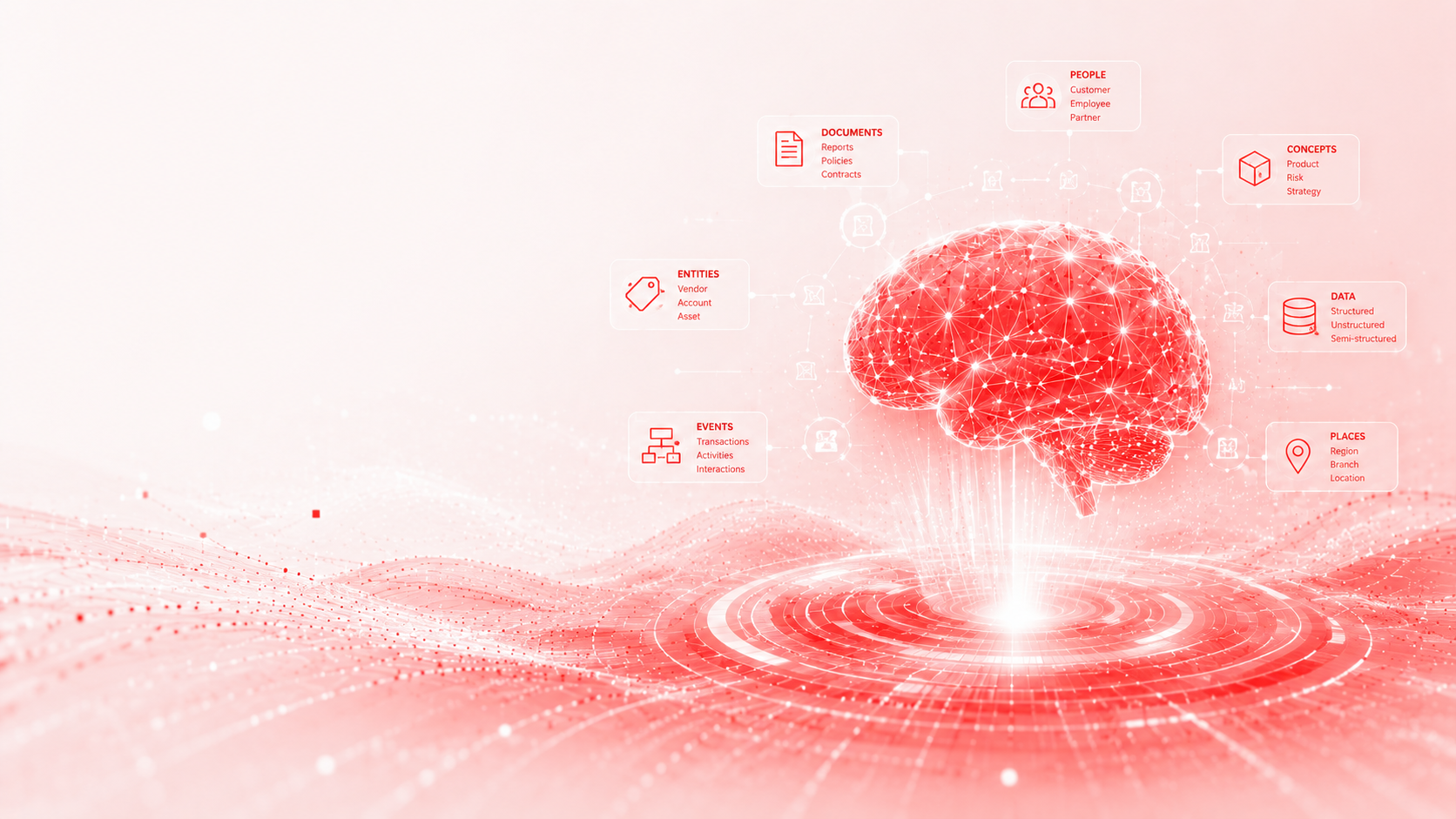
In EnWise engagements, semantic intelligence is treated as the engineering layer that turns the data estate into a knowledge estate. Where the analytics and platform disciplines move and store data, semantic intelligence interprets it - attaching identity to entities, relationships to facts, structure to documents, and definitions to language - and produces a connected representation that machines and humans can both reason over.
The output of a EnWise engagement is therefore a working semantic substrate - ontologies, taxonomies, knowledge graphs, NLP pipelines, embedding indexes.
The EnWise practice is organised around four interlocking capability themes. Each is a discipline in its own right, and each is delivered by Entiovi as part of a single semantic substrate rather than as a stand-alone tool deployment.
The interpretation of text and conversation as structured information.
Entity recognition, relationship extraction, intent detection, classification, sentiment, summarisation, and the orchestration of large language models for enterprise interpretation tasks. The output is not a bag of probabilities; it is structured data drawn out of unstructured language, reliable enough to feed downstream systems.
Explore Natural Language Processing 02The encoding of entities, relationships, and the rules that connect them as a queryable, governed graph.
Customer hierarchies, product taxonomies, organisational structures, regulatory frameworks, supply chains, and policy networks rendered in a representation that supports inference, traversal, and explanation - not just lookup.
Explore Knowledge Graphs 03The ability to ask questions of meaning, not only of measure.
Semantic search, embedding-based retrieval, similarity, clustering, concept-level analytics, and the cross-modal queries that connect documents, conversations, transactions, and entities under a shared definition. The discipline that lets the enterprise analyse what is happening conceptually, not only what is happening numerically.
Explore Semantic Analytics 04The end-to-end engineering pipeline that converts raw enterprise data into curated semantic assets.
Ontology design, schema mapping, entity resolution, knowledge extraction, validation, and the operating model that keeps the resulting knowledge layer current as the underlying data evolves.
Explore Data-to-Knowledge TransformationEnWise engagements are most consequential where the value of the underlying data is locked inside its language, its structure, or the relationships between entities that no current system can see end-to-end.
Enterprise semantic search and retrieval grounded in the organisation's own taxonomies, entities, and access policies - replacing keyword search across knowledge bases, contracts, policies, claims files, research libraries, and case archives.
Knowledge graphs of customer, product, counterparty, regulatory, and organisational entities - underpinning relationship intelligence, fraud and AML investigation, supplier risk, market analysis, and the retrieval substrate for generative AI workloads.
Document understanding programmes for contracts, regulatory submissions, claims, clinical documentation, KYC packs, technical manuals, and engineering specifications - with extraction quality engineered to the standard the workflow requires.
Ontology and taxonomy programmes that give the enterprise a single, governed model of its products, services, customers, regulators, and operating concepts - ending the multi-system disagreements that fragmented data dictionaries produce.
Master data, entity resolution, and identity reconciliation across CRM, ERP, marketing, customer-success, and external data sources - producing the resolved entity layer that every downstream analytics and AI workload depends on.
Conversational analytics and voice-of-customer programmes that read transcripts, surveys, support tickets, social signals, and field notes as structured intent and topic data - not as a wall of text for analysts to read manually.
Regulatory and policy intelligence - reading evolving regulations and internal policies as structured obligations, mapping them to the firm's controls, and surfacing the gaps continuously rather than during the next audit.
Semantic substrate for generative AI and agentic workloads - the curated retrieval and reasoning layer that grounds enterprise GenAI in the firm's own meaning, and that lets agents act on entities they have actually identified.
Semantic intelligence is the engineered layer where data becomes understanding. Entiovi’s team will walk through where Natural Language Processing, Knowledge Graphs, Semantic Analytics, and Data-to-Knowledge Transformation fit into your stack.